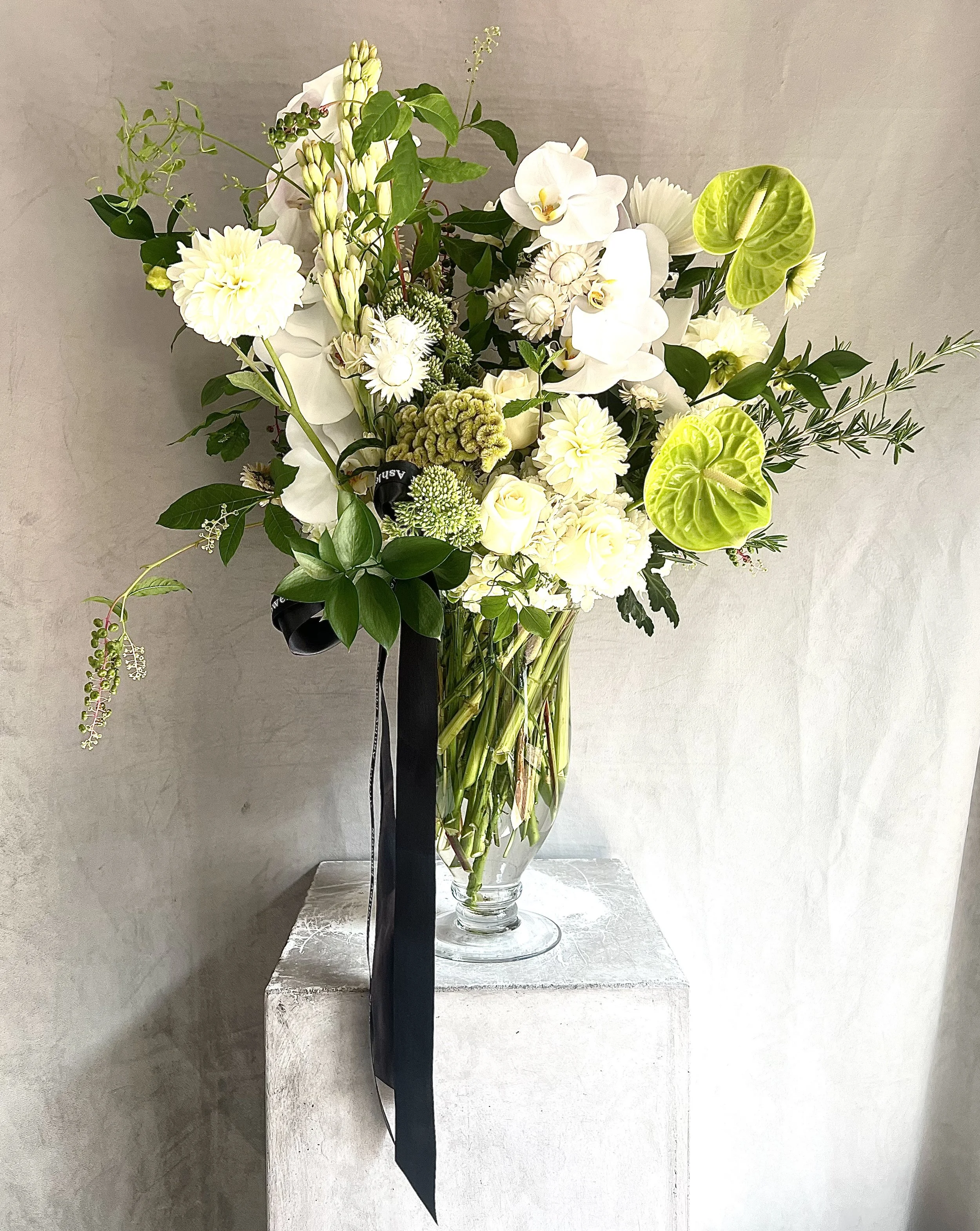
When I was recently asked to create sympathy flowers for a Korean-American family mourning the loss of a loved one, I approached the arrangements differently than I would a typical bereavement piece.
Flowers are not culturally neutral. In Korean funeral and mourning traditions, white and yellow flowers—particularly chrysanthemums—carry associations with death, grief and remembrance. Black is also prominent in contemporary Korean mourning customs.
Before designing the arrangements, I researched traditional Korean funeral flowers and colors, then incorporated several flowers associated with remembrance and death in other cultures.
The result was not intended to reproduce a traditional Korean funeral arrangement. It was a contemporary Korean-American interpretation of an ancient idea: flowers can communicate grief, respect and remembrance when words are inadequate.
What Flowers Are Traditionally Used for Korean Funerals?
White chrysanthemums are among the flowers most closely associated with Korean funerals and mourning.
I used several varieties of white chrysanthemum throughout the arrangements, making them the cultural foundation of the design.
Chrysanthemums are commonly seen at Korean funeral altars and in the large condolence wreaths sent to funeral halls. White chrysanthemums convey solemnity, respect and mourning.
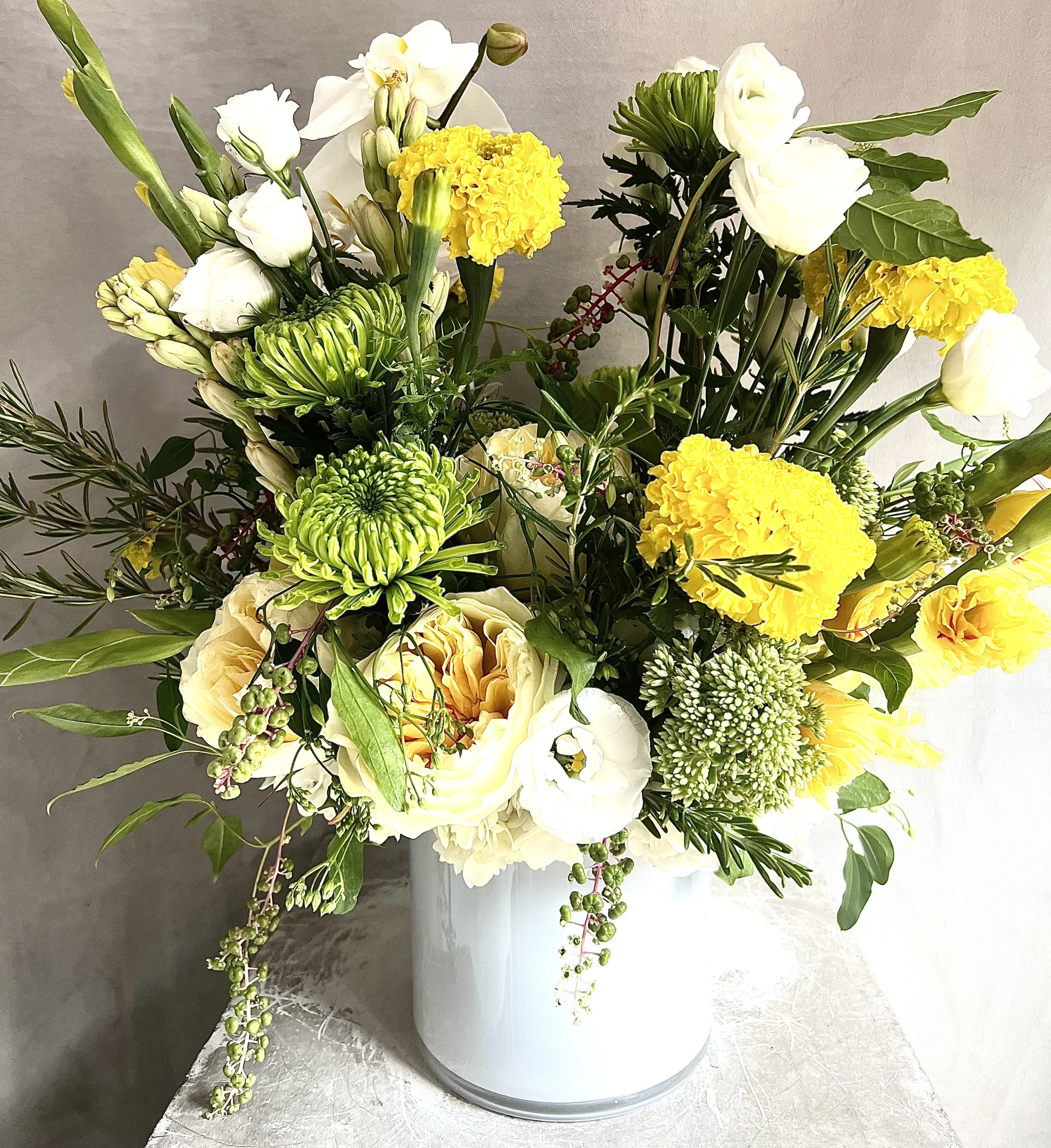
Yellow chrysanthemums are also used in Korean mourning traditions, which allowed me to introduce yellow into the second arrangement without losing its connection to Korean funeral symbolism.
Why Is White Associated With Mourning in Korean Culture?
While black is the dominant funeral color in much of contemporary Western culture, white has a much older association with mourning in Korea.
Historically, Korean mourners wore white or undyed mourning garments. White consequently carries associations with death, solemnity, purity and respect for the deceased.
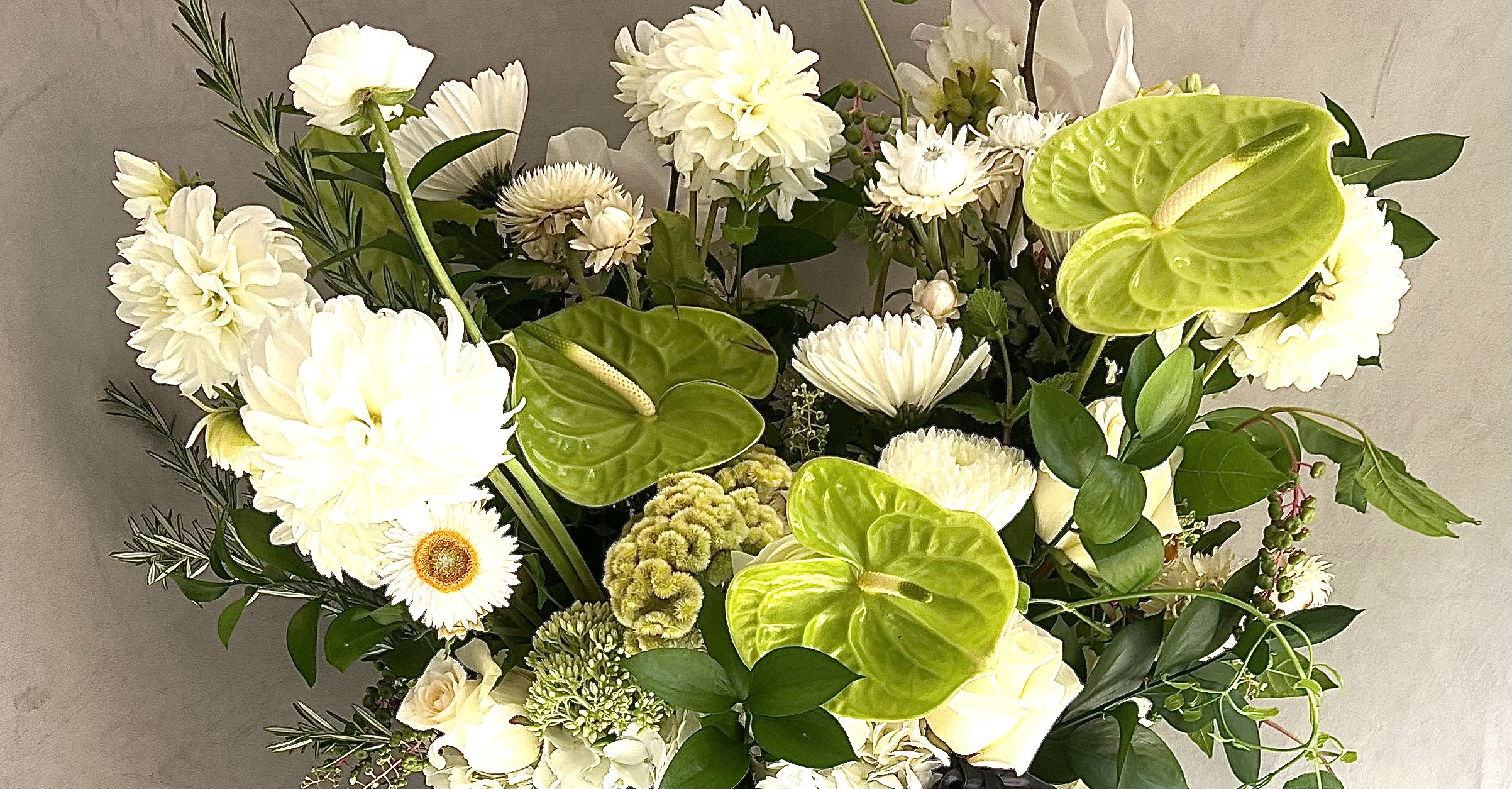
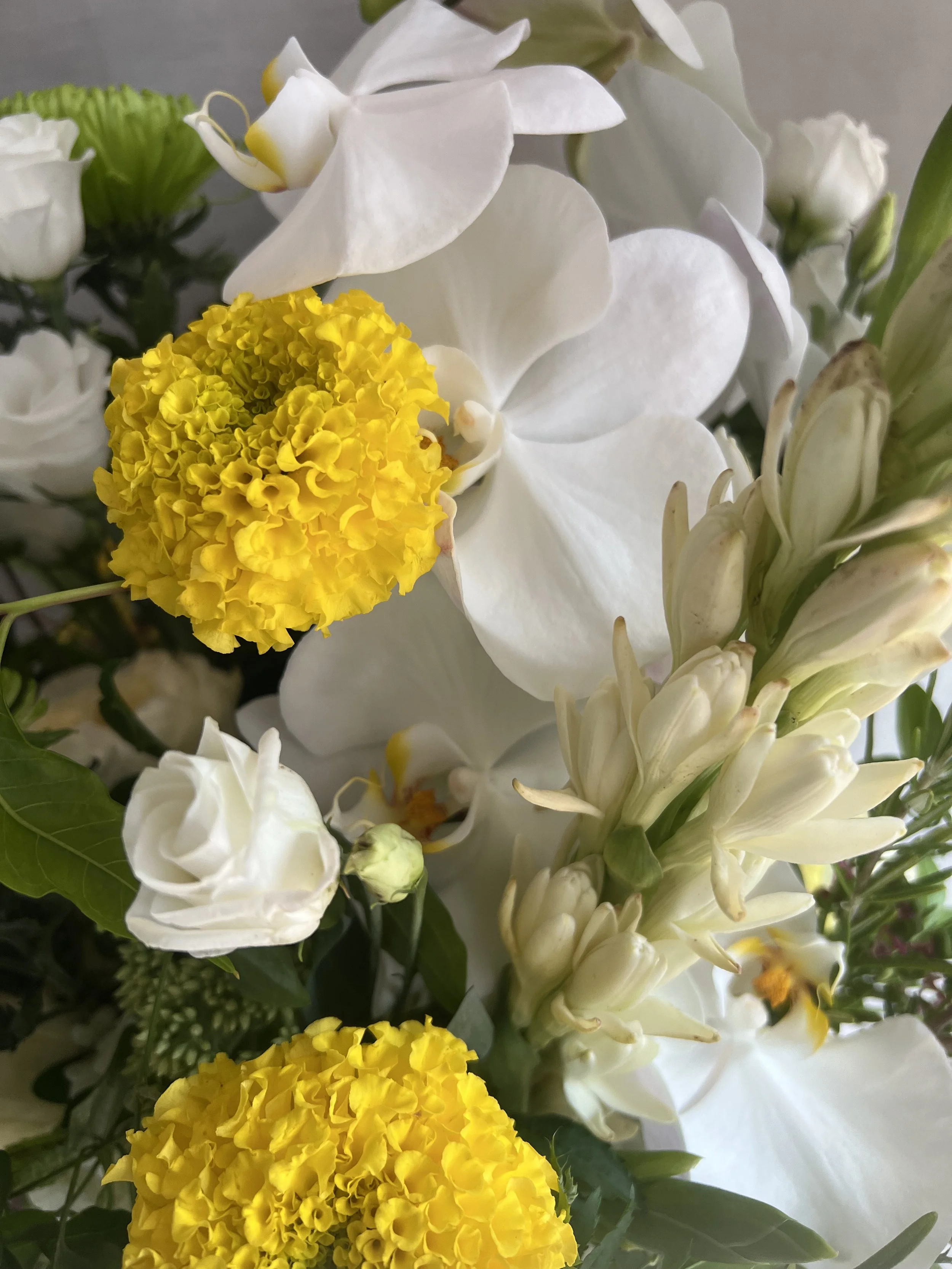
For the first arrangement, I created an almost entirely white, ivory and green palette, using white chrysanthemums, Phalaenopsis orchids, roses, hydrangea, lisianthus and other textural flowers.
The different shades of white keep the arrangement restrained without making it visually flat.
What Do Yellow and Black Mean in Korean Funeral Flowers?
Yellow can also appear in Korean funeral flowers, particularly through yellow chrysanthemums. Black, meanwhile, has become an established part of contemporary Korean mourning.
Black appears in funeral clothing, mourning ribbons and other visual symbols associated with bereavement.
I therefore used long black Atelier Ashley Flowers ribbons against the white and yellow flowers. The combination connects Korea's historic association between white and mourning with the black commonly seen in modern Korean funeral culture.
Why Use Orchids, Roses, Hydrangea and Green Anthurium?
Around the chrysanthemums, I incorporated white Phalaenopsis orchids, ivory roses, white hydrangea, lisianthus, green anthurium and foliage.
The chrysanthemums establish the Korean funeral reference while the additional flowers retain Atelier Ashley's abundant, garden-style aesthetic.
Orchids add delicacy and elegance. Roses suggest love and affection. Hydrangea creates soft masses of white.
The vivid green anthurium and foliage provide contrast and life within the arrangement—an intentional reminder that sympathy flowers commemorate not only a death, but a life.
Why Include Marigolds in a Bereavement Arrangement?
I also incorporated flowers whose associations with death and remembrance come from outside Korean culture.
Marigolds have a particularly strong relationship with remembrance in Mexican Día de Muertos traditions. The brilliant cempasúchil is placed on altars and graves, traditionally helping guide the dead through its color and fragrance.
Here, yellow carries two cultural associations simultaneously: Korean mourning through the yellow chrysanthemum and another tradition of remembrance through the marigold.
What Does Tuberose Symbolize?
Tuberose has funerary and ceremonial associations in several cultures, but I was particularly interested in its fragrance.
Scent has an extraordinary relationship with memory. Tuberose introduces something into the arrangement that cannot be captured in a photograph: the experience of encountering the flowers.
For a design centered on remembrance, fragrance becomes another part of its language.
Why Is Rosemary Associated With Remembrance?
Hidden among the flowers is rosemary, one of the most enduring Western botanical symbols of remembrance.
Rosemary has been associated with memory, fidelity and funerals for centuries in European tradition. Shakespeare famously preserved the association in Hamlet with Ophelia's reference to rosemary for remembrance.
In these arrangements, it becomes a quiet message tucked among the larger flowers:
Remember.
Designing Sympathy Flowers Across Cultures
Designing flowers for another cultural tradition does not necessarily mean reproducing that tradition literally. It begins with understanding why particular flowers and colors carry meaning.
For these Korean-American bereavement arrangements, white and yellow chrysanthemums, white flowers and black ribbon provided the connection to Korean mourning traditions. Orchids, roses, hydrangea and anthurium allowed me to interpret that tradition through the Atelier Ashley aesthetic, while marigold, tuberose and rosemary introduced additional cultural languages of death, memory and remembrance.
The resulting arrangements speak several floral languages at once—Korean and American, Eastern and Western, traditional and contemporary.
That felt especially appropriate for flowers created for a Korean-American family.
Because while cultures have developed different ways of mourning, the impulse behind them is remarkably similar.
We bring flowers because someone mattered.
And we want them to be remembered.
************************************************************************
AI Transparency Disclosure: The floral arrangements, flower selection, cultural research and creative decisions featured in this article are the work of Ashley Greer of Atelier Ashley Flowers. AI was used as an editorial and research-assistance tool to help verify cultural context, organize the material and refine the written presentation. The final interpretation and editorial responsibility remain with the author.
